


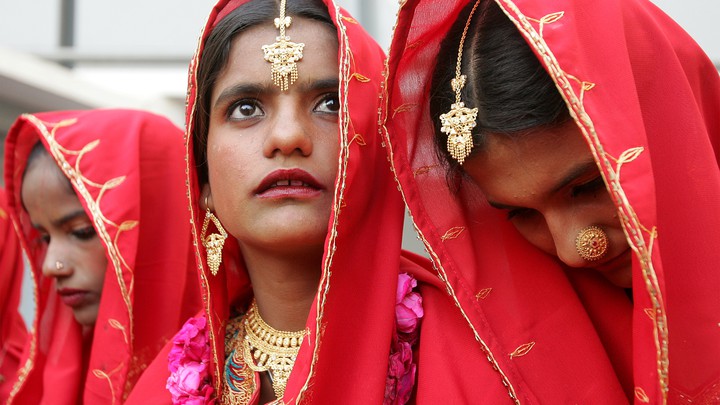
For the first 16 years of her life, Ravita Meghwar was a Hindu girl living in a village in Pakistan. But today her name is Gulnaz Shah, and she is married, and a Muslim. Her family members believe that kidnappers drugged them and abducted their daughter, and that she was forcibly converted to Islam. She says she eloped and married of her own choice.
A decade or two ago, Meghwar’s case would have gone unreported. But in recent years, case after case involving Hindu girls converting to Islam have emerged in courts in Pakistan’s southeastern Sindh province, home to the majority of the country’s Hindus. The allegedly forcible nature of the conversions, the almost identical pattern of the cases, and the targeting of minor girls have deeply unsettled the Hindu population, which constitutes about 2 percent of Pakistan’s approximately 200 million people. This sense of alarm feeds into a broader reckoning: 70 years after the partition of the Indian subcontinent, some Hindus are reassessing their place in Pakistan.
While Pakistan was created as a Muslim state in 1947, the country’s founder, Mohammad Ali Jinnah, said that religious minorities should have the freedom to live there and practice their faith. But today Pakistan’s identity is that of an Islamic nationalist state, hardline religious groups are a formidable force, and religious minorities have little voice in society. As influential Islamic shrines and religious groups work to convert people to Islam, some Hindus are leaving their villages and moving to cities in Pakistan, or leaving Pakistan altogether and moving to India.
Cases of forced conversion are mostly reported from the Sindh province, as Meghwar’s was this year. Although Pakistan became a Muslim-majority state post-partition—with Muslims dominating politics, the economy, and society—Hindus managed to retain a degree of social influence in the Sindh province, where they were known as successful merchants. According to the most recent available census, more than 6 percent of Sindh’s population is Hindu.
But lower-caste and low-income Hindus in Sindh toil on farmlands for powerful, rich landowners, sometimes in a form of economic servitude. They face social discrimination and are often cut off from the Hindu community at large. A 2015 report by the South Asia Partnership-Pakistan argued that social, cultural, economic, and religious factors have combined with feudal power structures in rural areas to enable forcible conversions.
Lajpat Meghwadh, Ravita Meghwar’s brother-in-law, believes she was targeted because her family was part of a larger political dispute in their village over the use of a well. “The person who Ravita has gone off with has no connection to the family, except that they had a dispute. He has never come to our house,” he said.
While Hindu activists and families allege that young girls are abducted, coerced into converting to Islam, and married off to Muslim men in an organized manner, Muslim religious activists and leaders are defensive about conversions, believing that converting someone to Islam is a way of earning blessings. These conversions are often backed by powerful shrines, seminaries, and clerics, as well as local politicians. Seminaries and shrines protect the couple and say the girl willingly eloped, converted, and married.
This poses a challenge for lawyers and activists, who have to figure out if these marriages are born of free will or are marked by threats and violence. And almost invariably, the girl’s testimony that she exercised her right as an adult to marry settles the case, while her parents continue to insist she is being pressured by the influential followers of the shrine where she converted to Islam.
Forced conversions became a national talking point in 2012, when three Hindu girls were reported to have been forcibly converted to Islam and married to Muslim men. The cases went to Pakistan’s Supreme Court. One of them involved a girl called Rinkle Kumari, whose conversion took place at a shrine associated with a legislator who was then part of the Pakistan Peoples Party, which governed the country at the time.
In court, the women said they wanted to live with their husbands, though activist Mangla Sharma, a member of the Pakistan Hindu Council, told me Kumari wanted to go back to her parents. The court said the women were free to be with their Muslim husbands.
“I went with Rinkle all the way to the Supreme Court,” Sharma said. “And I was very disappointed for a long time, that nothing can happen. … After Rinkle’s case, there was a sense of disappointment in the community. A lot of people were thinking about migrating at that time. Of course, some people have government jobs and can’t leave. Or there are people like me who think that there are just a few people left to raise a voice. If we leave, then what will happen to those who can’t protest?”
After Kumari’s case and a wave of activism around conversions, the Sindh legislature passed a bill in 2016 outlawing forcible conversions and conversions before the age of 18. The landmark legislation faced instant criticism from hardline religious groups—including Jamaat-ud-Dawa, widely believed to be the public face of the militant network, Lashkar-e-Taiba, which is accused of carrying out the 2008 attacks on landmarks in Mumbai. Right-wing groups banded together to form an opposition movement. In a statement at the time, Muzammil Iqbal Hashmi, then-head of Jamaat-ud-Dawa in Karachi, said, “It is not even conceivable to think of impediments to entering the fold of Islam.” The outcry led to the Sindh governor declining to sign the bill into law. Farooq Azam, a spokesperson for Jamaat-ud-Dawa, told me their opposition was to the entire legislation, and that the conditions it sought to establish were unacceptable.
“What we’re really fighting against is the mindset,” Sharma, the member of the Pakistan Hindu Council, said. “You don’t give a minor any other rights—yet you give a minor the right to suddenly change their life. When there were reservations [about the law] from religious elements, they said ‘There is no age in our religion to convert.’ My technical point is: There isn’t any age in your religion, in your law, but that doesn’t apply to our kids. We’re making this law for our children.”
In the absence of a law explicitly banning forced conversions, activists and lawyers are zeroing in on the cases of minor girls, using a different law that outlaws all marriage in Sindh below the age of 18. In the case of Meghwar, for example, Ali Palh, a lawyer associated with the Sindh Human Rights Defenders Network, intervened on the grounds that her elopement violated the law on underage marriage. “The girl is underage and can’t make up her own mind,” Palh said.
But a high court judge ruled that Meghwar could live with her husband. Judges, Palh told me, don’t look at the implicit compulsion at play in a case of a forced conversion that leads to a marriage.
Young girls aren’t the only ones being targeted for conversion. Mass conversions of Hindu families are taking place in Sindh, and many are reported to be lower-caste Hindus. Seminaries and clerics offer money and housing to new Muslim converts; they issue press releases when they convert someone to Islam, believing this to be a considerable achievement.
It’s unclear how and when forced conversions became such an organized movement. Most activists say this change took place over the past 15 years. They point to the enduring legacy of former president General Zia-ul-Haq’s regime in the 1970s and 1980s. The Haq government sought to make sharia the supreme law of Pakistan in an effort to Islamicize the country.
Now, the spate of conversions to Islam is changing the way Hindus live in a province that has been their home for generations. Lajpat Meghwadh said that Hindu families, including his in-laws, are leaving their villages for other cities in Sindh. Accurate counts of the Hindus leaving their villages are difficult to come by; there is only anecdotal evidence. As for Hindus leaving Pakistan altogether and migrating to India, one estimate put the number at 5,000 per year.
In Karachi, the capital of the Sindh province, stories of conversions and abductions routinely make the rounds among Hindus. Vijay Kumar, a former sailor, 36, lounged outside the Sri Laxmi Narayan temple with his family, pointing out his wizened grandmother, who used to travel between what is now Pakistan and India—“without a train ticket!”—before partition. He told me he had heard of hundreds of Hindu families that had migrated. “There were maybe a dozen-odd families of Hindu traders who had businesses in Sindh that used to live in my neighborhood,” Kumar said. “After these incidents started, there are now entire apartment buildings [in Karachi] filled with these families from [elsewhere within] Sindh.”
“The sense of antagonism between Hindus and Muslims has increased in the last 10 or 15 years,” said Maanjeet Chanderpaul, a retiree who lives on the grounds of the same temple. He said that people often tell him, “Well, look at what happens in your country.” They don’t mean Pakistan—Chanderpaul’s country—but India. As a Hindu, Chanderpaul is often construed as being Indian, even though Karachi has always been his home.
Sharma, for her part, says that while she studied Islam at school, she now fears that if her kids show any interest in Islam they’ll be targets for people looking to earn blessings by converting a Hindu. She routinely cautions her children that they may have close friendships with Muslims but that they could be susceptible to people looking to convert them. As a result of these tensions, she laments, there is distance instead of interfaith harmony.
Sharma and other activists I’ve spoken to believe that at the very least, the government realizes that forced conversions are a problem, but that it lacks the political will to tackle it and the ability to withstand the religious right wing’s pressure.
“Sometimes people ask me ‘Are you Pakistani?’” Sharma said. “I say ‘I’m a pure Pakistani.’ We’re those people that when we had an option, we didn’t go—we preferred to stay here.” She still plans to stick around: “We live here by choice,” she told me. But she added that had her elders known, back when they decided to stay in Pakistan, what today’s generation would have to face, perhaps they wouldn’t have made that choice.
We want to hear what you think about this article. Submit a letter to the editor or write to letters@theatlantic.com. SABA IMTIAZ is a freelance journalist based in the Middle East. She is the author of Karachi, You’re Killing Me! and No Team of Angels.
Source: The Atlantic