


 Hindu sages knew that the divine is infinite potential and has infinite expressions. We can access this limitlessness through the limitation of artificial and natural forms, even using icons … that the ignorant contemptuously refer to as idolatry. – Dr Devdutt Pattanaik
Why not [worship idols]? Who said how a Hindu or any human is supposed to worship the divine? Who made these rules?
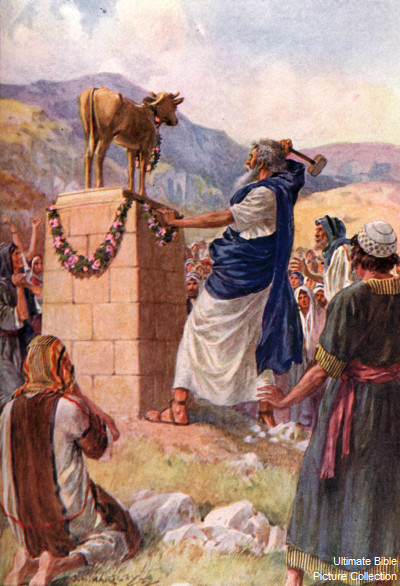
This question is rooted in Abrahamic myth that frowns upon God being given any form, and the Biblical condemnation of idolatry as indicative of a false religion. In the 19th century, as the British became masters of India, Hindus were pressurised to defend the practice of idol worship. And so many Hindu reformers went to the extent of saying that “true” Hinduism, in its pristine form (by which they meant Vedas), had no idols. That idol worship is a later-day corruption. However, many Hindu traditionalists rejected this idea.
The tension between giving God form and stripping God of any form is an ancient one. Before the British, it was the Muslim rulers of India who frowned upon idol worship. Their raid on temples, which was for political reasons and economic loot (temples were repositories of great wealth), was justified by stating it was an exercise against infidel idolatry. This influence of Islam led many Hindus to prefer the formless (nirguni, nirakar) divine, over divinity with form (saguni, sakar). So we find some bhakti followers using the name of God to refer to an abstract entity, while others use the names of Rama and Krishna or Kali to refer to a specific deity.
At a metaphorical level, idolatry refers to taking things literally. When we focus less on the idea and meaning, which is formless, than on the word or symbol, which is the form. An idea can be communicated only using a form (word, symbol, story, ritual). However, when the vehicle becomes more important than the content, when the form becomes more important than the idea, idolatry starts. We need idols (word, symbol, story, ritual) for the sake of communication. But we need to differentiate between the vehicle and the content. Every civilisation crumbles when the vehicle is taken literally at the cost of content. Those who take the vehicle literally are called fundamentalists; they do not bother with the underlying idea. So they see the idol as God, rather than a concrete expression of the idea of God.
For example, every year, in Mumbai, people bring clay images of Ganesha home, and worship him for a day or two, before immersing the image in the sea. The ritual makes one aware of the transitory nature of life—even God comes and goes, is created and destroyed. The ritual includes veneration (aradhana) which involves welcoming the divine, bathing them, offering them food, clothes, perfumes, lamps, incense, and finally words of praise, before bidding them farewell. Thus divinity is seen as a guest, and treated as guests are supposed to be treated.
The act involves concentration (dhyana). During the festival, the name of God is chanted and his stories told so that our mind is filled with ideas about life, death, existence, wealth, power, impermanence, relationships, sorrow, liberation, success, pleasure. We express our desires and hope these will be fulfilled by the deity. Thus, we are connected to a force larger than ourselves.
At the same time, the ritual involves engaging with friends, and family, and creating a sense of auspiciousness (mangalya) in the house, which generates positive energy. We realise how fragile life is and how lucky we are to have the good life.
We are asked to gaze upon the image (darshan) so that we realise in the elephant head and corpulent body the forces of earth that generate wealth and power, and how they are all impermanent, how even the hermit Shiva has to become a householder for the benefit of humanity at large. Thus, the ritual anchored by the idol harnesses the Hindu idea and helps the Hindu reconnect with Hindu-ness, a shift from his otherwise mundane material life, a moment to pause about existence and his role in the cosmos.
The outsider will see the ritual as “idolatry”. All rituals and prayers, of all religions, eventually seem like idolatry to the outsider, whether it is bowing to the image of Jesus hanging on a crucifix, or going around the Kaaba in Mecca, or singing before the menorah, or carrying the Granth Sahib in a palanquin, or dancing to the drum beat of tribal rituals in the forest. But the insider, who is immersed in the act, engages with the larger ideas of life and existence through the tangible vehicles created by his ancestors.
In the Vedas, Gods were embodied through chants (mantra). There was no material form. The only form was sound. As Vedic ideas spread, they mingled with the local faith of people who venerated earth’s fertility in the form of serpent-spirits (nagas) and tree-spirits (yakshas), as well as gods (bhutas, devas) who lived in water bodies, mountains, rocks and caves. The earliest temples were groves, or rocks by a river side, or a mountain peak.
Later, pillars were erected to mark a deity. Then, images were carved on stone or clay or metal. The Gods began to look more and more like humans, but sometimes with multiple heads and hands, sometimes part animal, sometimes part bird. Imagination congealed itself into imagery. In the Agama literature, detailed instructions are given on how to establish an idol in a temple and transform an idol into a deity through rituals known as breath-establishing (prana-pratithsha). These are vehicles of faith. Contained in the image and the ritual and the accompanying story is the idea that helps man discover the infinity described in the Vedas. It helps him bring the divine into his life.
Abrahamic faiths are uncomfortable with idols and images. Catholic faith is the only exception, where God is visualised as an old man and there is much art to show heaven, hell, prophets, angels and demons. The Protestants shunned art. The Muslims are forbidden to show images of the Prophet, though some artists in medieval Persia tried (keeping him veiled though). But the human desire to express divinity through art has not been crushed. Instead of human forms, Islamic artists used calligraphy and architecture to express the divine spirit. Others have used music to give the formless form. Hinduism has kept no restriction—divinity is expressed through nature, through artefacts, through trees and animals and humans and fantastic creatures.
Hinduism celebrates human imagination. Abrahamic religions fear human imagination and tend to restrict it using rules and norms and prohibitions against art. This tendency to control human imagination and expression of the divine is slowly creeping into Hinduism, with fundamentalism and attacks on artists. Everyone who seeks to control expressions of divinity seeks to contain divinity. But the wise Hindu sages knew that the divine is infinite potential and has infinite expressions. We can access this limitlessness through the limitation of artificial and natural forms, even using icons of Rama and Krishna and Durga and Ganesha, that the ignorant contemptuously refer to as idolatry. – Daily-O, 16 December 2017
» Dr Devdutt Pattanaik is an author, mythologist, and human resource management guru.
Source: https://bharatabharati.wordpress.com/2017/12/22/why-do-hindus-worship-idols-devdutt-pattanaik/